You started the essay with an assistant. Samesay turns that draft into your own voice and checks that every figure, name and citation survived, so what you hand in is yours to defend. Free account, no card needed.
Your draft
0 / 250 words
Strength
Fidelity on: every citation, figure, name, quotation and technical term of your draft is listed before the rewrite, checked against every version after it, and put back word for word wherever it changed. Sentences that state something your draft does not are removed. Free, for everyone.
Medium: closest to your draft., 1 pass of the HIP engine over your text. Medium keeps the most meaning; Max changes the most and needs a careful read. Versions are ranked by the meaning check, best first. English prose only; headings stay as they are.
Sounds like you, not like a model
Every figure and citation checked
Headings and structure kept
Never trained on your text
Under the hood
How AI text is humanized
Three steps, in the order the engine runs them. No trick against detectors, just the editing a careful reader would do, done in rounds and checked at the end.
Round 1 of 10
14.3%
Arrhenius
“may”
Smith, 2023
0Style score
Step 1
Find the tells
The engine reads your draft the way a tired marker does. It marks the stock openers, the filler connectors, the sentences that all run the same length and the hedges stacked three in a row.
Nothing is rewritten yet. Every mark is a place where the draft sounds like a model rather than like you.
Step 2
Rewrite the delivery, not the content
Round after round, the marked passages are rewritten so the rhythm varies and the wording moves toward how a person writes. Medium is three rounds, Extra five, Max ten.
The argument, the figures and the structure are off limits. Each round starts from the last one, which is why a stronger setting drifts further.
Step 3
Check what survived
Every figure, name, citation and careful qualifier is compared with your draft. The version gets a style score, and anything that drifted is flagged in the editor before you copy a word.
Then it is your turn: read it once, change what you would never say, hand in something you can defend line by line.
Step 1: Find the tells. The engine reads your draft the way a tired marker does. It marks the stock openers, the filler connectors, the sentences that all run the same length and the hedges stacked three in a row. Nothing is rewritten yet. Every mark is a place where the draft sounds like a model rather than like you.
Step 2: Rewrite the delivery, not the content. Round after round, the marked passages are rewritten so the rhythm varies and the wording moves toward how a person writes. Medium is three rounds, Extra five, Max ten. The argument, the figures and the structure are off limits. Each round starts from the last one, which is why a stronger setting drifts further.
Step 3: Check what survived. Every figure, name, citation and careful qualifier is compared with your draft. The version gets a style score, and anything that drifted is flagged in the editor before you copy a word. Then it is your turn: read it once, change what you would never say, hand in something you can defend line by line.
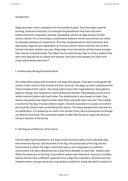
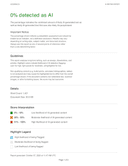
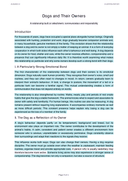
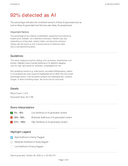
We wrote a 1,200-word essay on dogs and their owners with an assistant and ran it through an AI writing report. Then we humanized it at Max strength and ran the result through the same checker the next day. Both reports are below, unedited.
AI writing report · academi.cx6 October 2026
The draft, written with an assistant
92%detected as AI
0% low20% moderate51% high
Opening paragraphFlagged, high likelihood
For thousands of years, dogs have occupied a special place alongside human beings. Originally associated with hunting, protection and work, dogs gradually became companion animals and, in many households, genuine members of the family. This evolution shows that the relationship between a dog and its owner is not simply a matter of keeping an animal.
Dogs have been man's companion for thousands of years. They have been used for hunting, protection and work, but through the generations they have also been transformed into companion animals. Nowadays, almost all dogs are part of their owner's family. This is not simply a relationship between human and animal, but rather an everyday example of cooperation.
A 12,000-word university research proposal. GPTZero rated its original introduction 100% AI (“highly confident”). The whole proposal, rewritten at Max with Fidelity and its figures and citations checked afterwards, came back at 10% AI probability, “Human Generated”.
The text is not shown: it is its author’s own work. One document, one checker, a probability and not a verdict.
Same checker, same essay
Both reports come from the same AI writing report tool, 24 hours apart. Nothing was edited by hand between the rewrite and the second report.
Max strength, before the read-through
This run used Max as it was then, ten rounds. A few sentences came out rough, and you can see them in the report. That is why the editor asks you to read before you hand anything in.
A probability, not a verdict
A detector result is an estimate, and other checkers can disagree with this one. We publish the reports as they are, not a guarantee.
Use cases
Every piece of writing a semester throws at you
And the writing after graduation too. Pick one.
Essays and papers
You built the argument with an assistant and the draft reads like everyone else's. Samesay rewrites it in a voice that is yours, keeps every citation and figure where it was, and shows you what moved. You still read it once before it carries your name.
Tip: Medium strength, two versions, then pick the one that sounds like how you talk in seminar.
The basics
What an AI humanizer changes, and what ours leaves alone
A humanizer rewrites text that sounds machine-made. Samesay is the editor between an AI draft and the version you are willing to put your name on: it keeps the content and changes the delivery, so the argument stays and the voice becomes yours.
Four habits it removes, with the kind of sentence each one produces. Facts, figures and headings are left alone.
Stock phrasing
Openers and filler that every assistant uses and every reader recognises.
In today's fast-paced world, it is important to note that…
Today, …
Flat rhythm
Sentence after sentence of the same length and shape. People write with more variety.
Sentences of 18, 19, 18 and 20 words in a row.
A short one. Then a longer one that carries the detail.
Connector overload
Moreover, furthermore, additionally: links that announce logic instead of showing it.
Moreover, the team… Furthermore, the budget…
The team… The budget, meanwhile, …
Dash habits
Em dashes everywhere. We use commas, colons, brackets or a new sentence, and keep ranges like 2023–2025.
The plan — once approved — will start.
Once approved, the plan will start.
Why Samesay
Three things you can hold us to
Not features. Commitments, each one visible in the editor.
Every figure and name, checked
Numbers, units, names, citations, negations and words like "may" are compared with your draft after every rewrite. What drifted is flagged, one click shows every word that moved, and your headings stay exactly as you wrote them.
No detector magic, just the reports
Detectors disagree with each other and change every month, so we never promise a pass. We publish our own reports instead, and give you a deliberately sensitive style checker and a style score that says which habits are left.
Your words stay yours
A published method running on our own GPU, not a third-party AI service. Nothing is stored with history off, nothing is used for training, nothing is shared with detector companies. Delete everything in two clicks.
Pricing
Priced for a student budget
1 500 words a month free, Basic for the price of two coffees, credits for exam weeks, a pay-as-you-go API. No card to start.
Basic
$10 / month
or $80 a year
30,000 words a month, up to Extra strength and 2 versions per rewrite, 600 words per text.
Pro
$20 / month
or $160 a year
60,000 words a month, up to Max strength and 3 versions per rewrite, 1,500 words per text.
Ultra
$50 / month
or $400 a year
100,000 words a month, up to Max strength and 3 versions per rewrite, 3,000 words per text.
Our engine implements Humanization by Iterative Paraphrasing, a 2026 method from Carnegie Mellon: a base language model, which writes closer to people than any assistant, rewrites your text in passes. Around it we built what the paper leaves out: a meaning check on every version, a second model that repairs lost figures and names, and an evaluation that measures what survived instead of chasing detector scores.
Published method
Xu and Kolter, CMU, arXiv 2605.19516
Our own hardware
Rented GPU, nothing stored, no third-party AI
Measured, not promised
Preservation of figures, names and hedges
Open about limits
We cite the study that found the method only partly effective
It takes a draft, usually one you started with an AI assistant, and rewrites it in a voice that reads like a person: yours. Then it checks that the rewrite still says the same thing, figure by figure and name by name. Every rewrite comes with a human-like score, a style score and a meaning check.
Is this just another tool to bypass AI detectors?
No, and we say so on every page. Detectors disagree with each other, change monthly and are wrong about individual texts in both directions, so any tool that promises a pass is guessing with your grade. Samesay is for the step after the draft: making it yours, keeping it accurate, and handing in something you can explain line by line.
Is it allowed for my course?
That depends on your institution and your lecturer. Many allow AI help for some tasks and not others, and some ask you to declare it. Check the rules for the assignment first, and when in doubt, ask. Our terms ask you to follow those rules; the tool is for writing you are allowed to get help with.
I wrote it myself and a detector flagged it. Can Samesay help?
Yes, and this is one of the most common reasons students come to us. Careful writers, and especially people writing in English as a second language, produce exactly the even, well-connected prose detectors associate with machines. Paste your text in the style checker to see which habits are being counted, then rewrite at Medium strength to loosen them while keeping every point you made.
How many style checks do I get?
5 a month without an account, 20 on Free, 50 on Basic, 200 on Pro and 1,000 on Ultra. The AI-style score is tuned to be sensitive, so use the breakdown and the highlighted sentences, not just the number.
What is the style score?
A 0 to 100 measure of writing habits, from our own rules: stock phrases, flat sentence rhythm, dashes, filler connectors and similar. Higher means fewer habits. It is not a prediction of what any detector will say.
 Open the full reportPDF, 4 pages, every paragraph as the checker marked it.